The Noble Excuse
There's a version of procrastination that looks nothing like procrastination. It has a different name — usually a virtue. Clarity. Patience. Thoroughness. The kind of word that makes hesitation sound like wisdom.
The reason this is worth naming is that it compounds. One noble excuse keeps a decision in limbo. Several of them, running in parallel, mean nothing moves. The longer an excuse holds, the more legitimate it looks — because time spent waiting feels like deliberation. By the time someone else has moved, or the window has closed, the excuse has aged into a story about why the timing was wrong.
For high performers, especially, this is the most expensive pattern. The skills that got you here — carefulness, consideration, attention to quality — are the exact virtues that get recruited for avoidance. You're not playing small. You're playing carefully. And careful, left unchecked, plays out the same way.
The Five Families
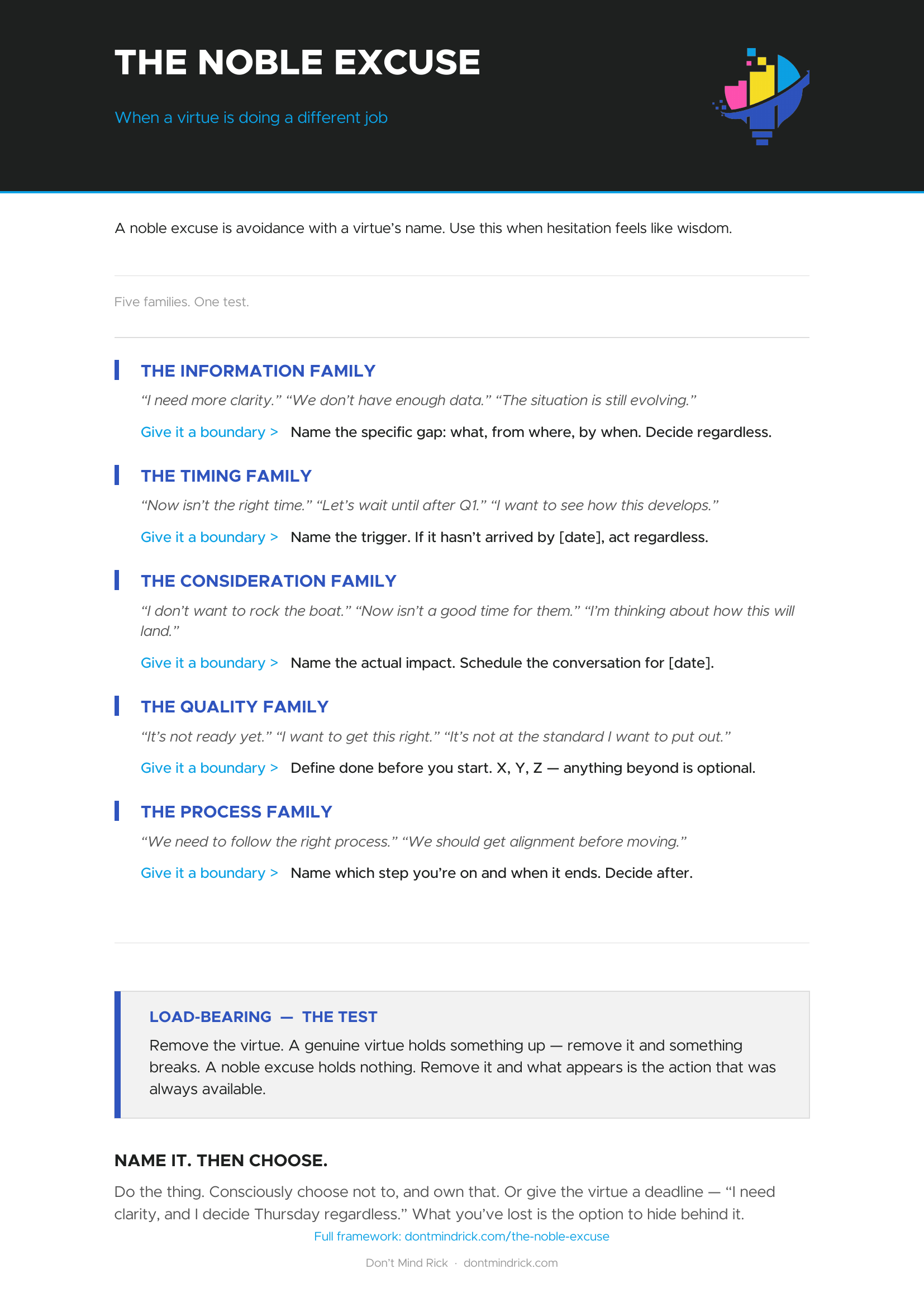
Noble excuses come from five families. Each family has a real version — the virtue that earns its name — and a borrowed version that uses the same language for a different job.
A family here means a cluster of related excuses that all protect the same thing and respond to the same test. If you find one, you've probably found the others nearby.
1. The Information Family
Examples: "I need more clarity." "We don't have enough data." "I want to understand this better first." "The situation is still evolving."
How to recognise it: The information being waited for is either unavailable, already sufficient, or has been available for a while without being acted on. Each time existing information is provided, the request expands.
How do I know this is the Information family? The language centres on not knowing enough, or not knowing yet. The feeling is one of suspended judgment — reasonable in tone, forward in orientation, but never arriving.
Why this is a problem: Decisions deferred on information grounds rarely resolve when the information arrives. A new gap appears. The cost isn't only the delay — it's the signal to anyone waiting on you, and the narrowing of the option space as time passes. Windows close. Others move. What looked like patience starts to look like indecision, because that's what it is.
Left unaddressed: The decision gets made for you — by circumstance, by someone else, or by the cost of the delay itself becoming too high to recover from.
The legitimate version: A decision genuinely requires specific information you don't have, that information is obtainable, and the cost of waiting is lower than the cost of deciding wrong. The request has a finite shape: specific, sourced, and time-bounded. If that's what's happening, you're not in this family.
Remove it: Take away the information request. With what you currently have, what would you decide? If the answer is clear, the information was never the issue. If it's genuinely unclear, name the specific gap: what information, from where, by when.
Give it a boundary: "I need more clarity" becomes: "I need X specifically, and I decide by Thursday, regardless." A genuine information need has a shape and an end date. A noble one doesn't.
2. The Timing Family
Examples: "Now isn't the right time." "Let's wait until after Q1." "The conditions aren't ideal." "I want to see how this develops."
How to recognise it: The right moment keeps moving. The condition named either isn't specific ("when the time is right") or has been met, but the action hasn't followed. The reasoning shifts each time a condition resolves.
How do I know this is the Timing family? The language centres on sequence — after X, once Y happens, when Z is clearer. There's always a reasonable next marker to wait for. The feeling is anticipatory, even strategic.
Why this is a problem: Timing excuses can appear deliberate. But "deliberate" without a concrete trigger is deferral with good posture. Every round of waiting narrows the options and extends the distance between you and the action. By the time you move, the window may have changed shape — or closed.
Left unaddressed: The moment never arrives on its own. Circumstances produce new reasons to wait. When you finally act, it carries more cost and less leverage than it would have earlier.
The legitimate version: A specific, named condition genuinely changes the quality of the decision if waited for, and the cost of waiting is demonstrably lower than acting prematurely. The condition is concrete, not directional. If that's what's happening, you're not in this family.
Remove it: Take away the condition. If you had to act this week, what would you do? If that surfaces a plan, the timing was always available. If it surfaces discomfort, that's what needs examining.
Give it a boundary: "After Q1" becomes: "If X hasn't happened by April 3rd, I act regardless." A genuine timing consideration has a trigger and an expiry. A noble one just has a direction.
3. The Consideration Family
Examples: "I don't want to rock the boat." "I'm thinking about how this will land." "Now isn't a good time for them." "I want to be sensitive to the situation."
How to recognise it: The consideration is consistent, but the action never follows. The timing concern for the other person refreshes each cycle. The person being considered hasn't asked to wait — or has, and is now in limbo longer than they'd prefer. The uncomfortable conversation remains yours to avoid.
How do I know this is the Consideration family? The language centres on someone else — their state, their readiness, their reaction. The frame is empathetic, even caring. But if you traced the benefit of waiting, it runs mostly in your direction.
Why this is a problem: Hiding avoidance behind consideration involves a third party who doesn't know they're part of the story. They're waiting on something. They may be making plans around your silence. The longer this runs, the larger the gap between what they assume and what you know — and the harder the conversation becomes when it finally arrives.
Left unaddressed: The other person adapts around your silence. When the conversation finally happens, you're dealing with the original issue plus the secondary damage of the delay.
The legitimate version: Another person's circumstances genuinely affect whether the action helps or harms — and the delay serves their interests, not yours. You can name specifically what you're protecting them from, and when that concern resolves. If that's what's happening, you're not in this family.
Remove it: Remove the consideration. If their circumstances weren't a factor, what would you do? If the answer is clear, the consideration was yours to own, not theirs.
Give it a boundary: "I don't want to rock the boat" becomes: "This will be uncomfortable for X, and I'll have that conversation by [date]." Genuine consideration produces a timeline. Noble consideration produces indefinite waiting.
4. The Quality Family
Examples: "It's not ready yet." "I want to get this right." "I need to refine this a bit more." "It's not at the standard I want to put out."
How to recognise it: The standard keeps rising as the work improves. What was "almost there" yesterday is still almost there today. The refinements are getting smaller but the time investment is getting larger. No one else has flagged the quality gap — only you.
How do I know this is the Quality family? The language centres on the work itself — its current state versus a standard. The feeling is a craftsman's discomfort. The work is almost right. But the finish line keeps moving.
Why this is a problem: The cost of quality avoidance isn't only the delay — it's the compounding investment in work that isn't shipping. Time spent refining what's already sufficient is time taken from the next thing. For work others will evaluate, prolonged non-delivery becomes its own signal, separate from the quality of the work. The reputation risk that perfectionism was supposedly protecting against ends up being created by the delay.
Left unaddressed: The work either ships late with only marginal improvement, or doesn't ship at all.
The legitimate version: The work has a real, specific gap between its current state and what's needed — nameable, closeable, and worth the cost of the delay. The standard was defined before the work started, not raised as it improved. If that's what's happening, you're not in this family.
Remove it: Remove the quality standard. If this had to go out today, what specifically would be missing — and would anyone other than you notice or care? If the gap is invisible to the people who matter, it was never about quality.
Give it a boundary: "It's not ready yet" becomes: "Done means X, Y, Z — anything beyond that is optional." A genuine quality bar is specific and pre-defined. A noble one has no floor.
5. The Process Family
Examples: "We need to follow the right process." "I want to make sure we do this properly." "We should get alignment before moving." "There are steps to this."
How to recognise it: The process itself becomes the focus, rather than the outcome it was designed to serve. Steps are added, not removed. Alignment is sought from more people than the decision requires. The process completes and another step appears.
How do I know this is the Process family? The language centres on procedure and correctness — doing things properly, in the right order, with the right people. The implicit message is that the delay isn't avoidance — it's discipline.
Why this is a problem: Process as avoidance compounds. Every step drawn out becomes its own precedent. Others involved adapt their timelines around your pace. If the process is being used to defer accountability, that becomes visible over time — and the trust lost is harder to rebuild than the decision was to make.
Left unaddressed: The process runs until the decision is made for you, or until the cost of maintaining it exceeds the cost of whatever was being avoided.
The legitimate version: The process exists for a real reason — it protects against specific risks or ensures the right people are genuinely informed — and skipping it has consequences you can name. The steps have a defined end. If that's what's happening, you're not in this family.
Remove it: Remove the process requirement. If you could decide right now, without the alignment or the steps, what would the decision be? If you know the answer, the process was never the obstacle.
Give it a boundary: "We need proper process" becomes: "Step X is complete by [date], then we decide." A genuine process has a sequence and an end. The noble process has neither.
Load-Bearing
A virtue of doing real work is that it holds something up. Remove it, and something breaks — a relationship suffers, an outcome degrades, a risk goes unmanaged.
A noble excuse holds nothing. Remove it, and what appears is the action that was always available — the decision, the conversation, the thing to ship.
That's what removal reveals. Not whether you value the virtue. Whether it's doing the job it claims.
The Tell
There's a secondary signal worth knowing.
Challenge a genuine virtue, and it gives a short answer. It would damage something specific and real, and it can name what.
Challenge a noble excuse, and it grows. New reasons appear. The explanation becomes more elaborate. That's not wisdom developing — that's avoidance, building a stronger fence.
Name It. Then Choose.
Once you've named it, you can't use it the same way again.
There are three honest positions. Do the thing. Consciously choose not to, and own that. Or give the virtue a deadline — "I need clarity, and I'll decide Thursday regardless." The last one converts a noble excuse into a genuine virtue. It gives patience a bound and consideration a date.
What you've lost is the option to hide behind it.
If you got this far, here's the short version you can download and reuse when you need to run the check